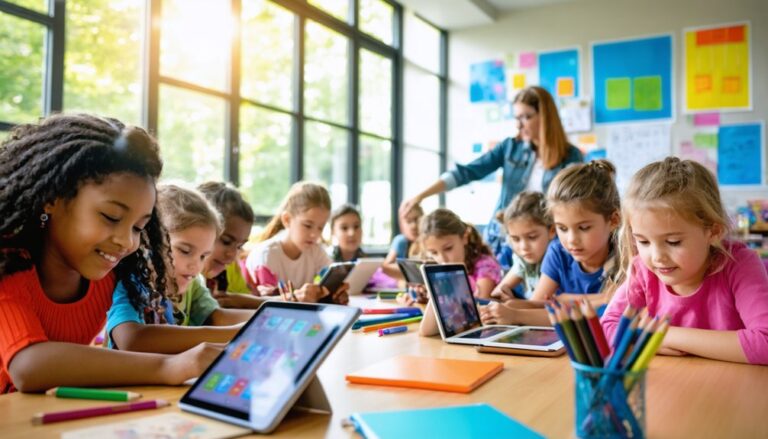
Personalized learning is becoming the future of education due to its ability to cater to individual student needs and preferences. This approach promotes enhanced academic performance, increased student engagement, and improved attendance and retention rates. The integration of AI and adaptive learning technologies further personalizes educational experiences. As innovations such as virtual reality and mobile platforms emerge, they will make learning more accessible globally. Future developments hold even greater potential for revolutionizing education.
Highlights
- Personalized learning tailors educational experiences to individual student needs, enhancing engagement and motivation, leading to better academic performance.
- AI-driven adaptive learning programs significantly improve test scores, showcasing the effectiveness of personalized approaches over traditional methods.
- High retention and attendance rates in personalized programs indicate their success in fostering student engagement and a sense of belonging.
- Emerging technologies like VR and AR facilitate immersive learning, making education more accessible and relevant to diverse learner populations.
- The rapid growth of the personalized learning market emphasizes its potential to transform education and meet modern workforce demands through tailored learning paths.
The Rapid Growth of the Personalized Learning Market
The personalized learning market is experiencing outstanding growth, with projections indicating a substantial increase in value from $6.01 billion in 2025 to $15.32 billion by 2029, reflecting a compound annual growth rate (CAGR) of 26.4%. Key market trends reveal a significant rise in hyper-personalized learning, expected to expand from $3.8 billion in 2025 to $27.4 billion by 2035. Industry perspectives highlight the impact of AI, projected to soar from $6.5 billion in 2024 to an astounding $208.2 billion by 2034. This growth is fueled by advancements in data analytics, increasing demand for customized educational solutions, and the adoption of cloud-based platforms. Additionally, the integration of AI into personalized learning methodologies is driving the customization of educational experiences. As a result, the market is positioned for energetic evolution, nurturing an inclusive and responsive learning environment. The Software & Platforms segment, which is expected to lead the market with a significant share of 58.7% in 2025, highlights the strong reliance on technology in transforming educational methods. Furthermore, the North American market holds a significant revenue share, driven by advanced technological infrastructure and substantial investments in AI and education technology.
Enhanced Academic Performance Through Personalization
Personalized learning initiatives aim to enhance academic performance by tailoring educational experiences to individual student needs. However, mixed research evidence indicates that achievement gains in personalized classrooms can often resemble those in traditional settings, with teachers employing similar teaching strategies. While technology-enabled adaptive instruction demonstrates potential, especially in diverse socioeconomic situations, its effectiveness is inconsistent among struggling learners. Some studies reveal that lower-performing students may not benefit as substantially as their more competent peers, raising concerns about equitable learning outcomes. Interestingly, recent research findings highlight that there is no significant advantage of personalized learning over traditional learning in terms of student achievement. Although personalized plans correlate with increased motivation and belonging among students, definitive links to improved academic performance remain inadequately examined. Ultimately, the path to seamless integration and quantifiable outcomes continues as education evolves to meet varied learner profiles, and educators must plunge to investigate this issue further in a relevant framework. Moreover, student demand for personalized learning underscores the importance of adapting education to fit each learner’s interests and needs. Addressing students’ self-regulatory skills is essential for personalized learning to avoid widening differences in educational outcomes.
Boosting Student Engagement in Learning Environments
Engaging students in learning environments requires a subtle understanding of their motivations and individual needs. Personalized learning effectively addresses diverse student needs, allowing for autonomy in exploring interests and becoming proficient in content at their own pace. This flexibility diminishes traditional learning barriers, making education more relevant and engaging. Research shows that personalized AI learning environments increase motivation, with 75% of students feeling more engaged compared to only 30% in conventional settings. Additionally, positive teacher-student relationships and support enhance emotional and social learning, further promoting student participation. Furthermore, AI-powered personalized learning experiences have been shown to lead to a 70% better course completion rate, underscoring the significant impact of tailoring education to individual student needs. This aligns with the finding that external factors such as teacher behavior significantly influence student engagement. Implementing personalized learning as a strategy is also a key response to help recover and re-engage students post-pandemic.
Improving Attendance and Retention Rates
When schools adopt personalized learning strategies, they often witness significant improvements in student attendance and retention rates. Research indicates a notable 12% increase in attendance and a staggering 94% retention rate within programs that personalize educational experiences. These outcomes stem from customized learning strategies that align with individual interests and nurture deeper student engagement. For instance, personalized environments enhance students’ commitment to academic success, particularly among at-risk populations, leading to a marked decline in dropout rates. Improved attendance patterns, especially in rural areas, highlight the potential of personalized approaches to combat educational inequities. Consequently, personalized learning not only boosts academic outcomes but also cultivates a sense of belonging and community integral to student success. Additionally, adaptive learning technology plays a crucial role in creating tailored experiences that further enhance student retention. Moreover, schools utilizing personalized learning strategies reported a 12% increase in student attendance and a 15% drop in dropout rates, showcasing the effectiveness of these methods.
The Role of AI in Adaptive Learning Capabilities
As educational institutions increasingly seek effective strategies to enhance learning outcomes, the role of artificial intelligence (AI) in adaptive learning capabilities has emerged as a revolutionary force. AI assistance leverages learning analytics to continuously tailor educational experiences, ensuring that students receive the support they need when struggling with concepts. This personalized approach has led to an outstanding 62% increase in test scores among users of AI-powered adaptive learning programs. Moreover, immediate feedback from AI enables real-time adjustments, allowing students to correct misconceptions quickly. By identifying knowledge gaps before they widen, AI enhances engagement and accelerates progress. Additionally, AI-powered adaptive learning technologies provide personalized feedback and instruction to cater to individual student needs. As a result, AI education is becoming increasingly advanced with dual support of large-model technology and deep learning algorithms.
Future Innovations in Personalized Learning Technologies
The scenery of personalized learning technologies is on the brink of revolutionary innovations. As affordability of virtual reality (VR) and augmented reality (AR) equipment accelerates adoption, educators are leveraging immersive storytelling to revolutionize learning experiences. Emerging virtual mentorship programs will offer real-time guidance, enhancing engagement and driving skills-based credentialing systems that prioritize microcredentials over traditional degrees. AI-driven immersive environments facilitate customized educational paths, resulting in improved course completion rates and heightened motivation among students. With AI integrating real-time skills gap analysis, learners are better prepared for the demands of the modern workforce. These advancements pave the way for lifelong adaptive learning structures, enabling students to thrive in a continually changing educational environment, nurturing a strong sense of belonging within their communities. AI-driven personalised learning systems are crucial in tailoring education to meet diverse learner needs and preferences. Furthermore, the adoption of skills-based organizations emphasizes the importance of aligning learning experiences with the evolving needs of the job market. As AI supports personalized learning, it continually enhances the effectiveness of educational practices.
Emotional Intelligence in AI-Driven Learning
Emotional intelligence plays a critical role in AI-driven learning environments, substantially enhancing student engagement and academic success. Intelligent systems equipped with emotional recognition capabilities analyze data points, identifying students’ emotional states and tailoring educational experiences accordingly. With personalized AI approaches, 75% of students report increased motivation, and emotional support contributes 29% to improved learning outcomes. These systems also effectively reduce dropout rates by 15% by recognizing emotional risks early, promoting a sense of belonging and connection. Moreover, AI-driven environments enable self-paced progression, alleviating stress and nurturing intrinsic motivation. The implementation of AI-driven personalized learning platforms has been shown to significantly enhance learning outcomes in medical education, indicating the broader applicability of these technologies. Furthermore, the integration of AI-driven tools within educational settings can potentially increase overall happiness and reduce stress associated with academic workloads. Ultimately, the interplay between emotional engagement and cognitive learning enhances student experiences, making emotional intelligence an indispensable element of modern education. In fact, AI-driven platforms can tailor coursework to individual needs, further boosting student motivation and success.
Lifelong Learning: Adapting to Every Stage of Life
Lifelong learning has emerged as a fundamental component of personal and professional development across all stages of life. Research shows that individuals’ orientation toward lifelong learning increases gradually from education to career, highlighting the importance of adaptive learning strategies customized to different career development phases.
While younger learners demonstrate strong enthusiasm, older professionals benefit from mentoring and community engagement, nurturing a shared learning culture. Modern challenges, such as technological advancements, necessitate continuous skill updates, rendering traditional education insufficient. Developing educational formats, like microcredentials, allow professionals to acquire targeted skills in response to these changes.
Embracing lifelong learning not only enhances individual growth but also cultivates a sense of belonging within communities, nurturing collaborative progress through shared knowledge and experience.
Breaking Barriers: Global Access to Education Through Personalization
Education accessibility has undergone a revolutionary shift due to personalized learning technologies, which are breaking down traditional barriers.
The rapid growth of the AI in education market, projected to reach USD 208.2 billion by 2034, underscores a commitment to global education equity.
As mobile-first platforms expand access in low-infrastructure regions, personalized learning solutions empower diverse learner populations.
In Asia-Pacific, cultural emphasis on education drives a 48% CAGR, reflecting a demand for scalable EdTech infrastructure.
The integration of AI tools fosters real-time adaptations to individual learner needs, enhancing student engagement and performance.
References
- https://www.insightaceanalytic.com/report/ai-in-personalized-learning-and-education-technology-market/2692
- https://www.matsh.co/en/statistics-on-personalized-learning-effectiveness/
- https://www.apu.apus.edu/area-of-study/education/resources/the-benefits-of-personalized-learning/
- https://www.engageli.com/blog/ai-in-education-statistics
- https://www.powerschool.com/blog/complete-guide-personalized-learning-k12-education/
- https://www.cedtech.net/download/personalized-learning-through-ai-pedagogical-approaches-and-critical-insights-16108.pdf
- https://elearningindustry.com/how-ai-is-transforming-personalized-learning-in-2025-and-beyond
- https://blog.workday.com/en-us/ai-in-the-classroom-personalized-learning-and-the-future-of-education.html
- https://www.thebusinessresearchcompany.com/report/personalized-learning-global-market-report
- https://www.disco.co/blog/ai-powered-personalized-learning-platform